 |
| Irish Pearl Cords L to R: Size #5 Lanaknits Hemp, Size #10 Cebelia, and Size #20 Opera threads. |
Size #3 crochet thread is fairly equivalent in thickness to CYCA #2 Fine or US "sport weight" yarns {UK Light DK, AUS 5 Ply}; however, yarns don't necessarily behave like a cotton crochet thread of the same thickness. Jewelry patterns often require crochet thread because of its smooth, finely twisted and plied mercerized cotton, usually “z-twisted.”
Size #5 crochet thread is fairly equivalent in thickness to CYCA #1 Super Fine or US "fingering weight' yarn {UK & AUS 3 Ply or 4 Ply}; however, not all yarns behave like a cotton crochet thread of the same thickness, so substitutions may not work well. Six-strand cotton embroidery floss falls in this size range when crocheted with all 6 strands together.
Size #10 crochet thread: some thread crocheters call this popular size “bedspread weight.” It's lumped together with thinner thread sizes in the yarn industry’s catch-all “lace weight” category: CYCA #0 Lace weight yarn {UK & AUS ??}; and most lace weight yarns don’t behave like a cotton crochet thread of the same thickness. Most of my thread crochet jewelry is designed for use with smooth, finely twisted and plied mercerized cotton, preferably “z-twisted” (i.e. has a counterclockwise twist).
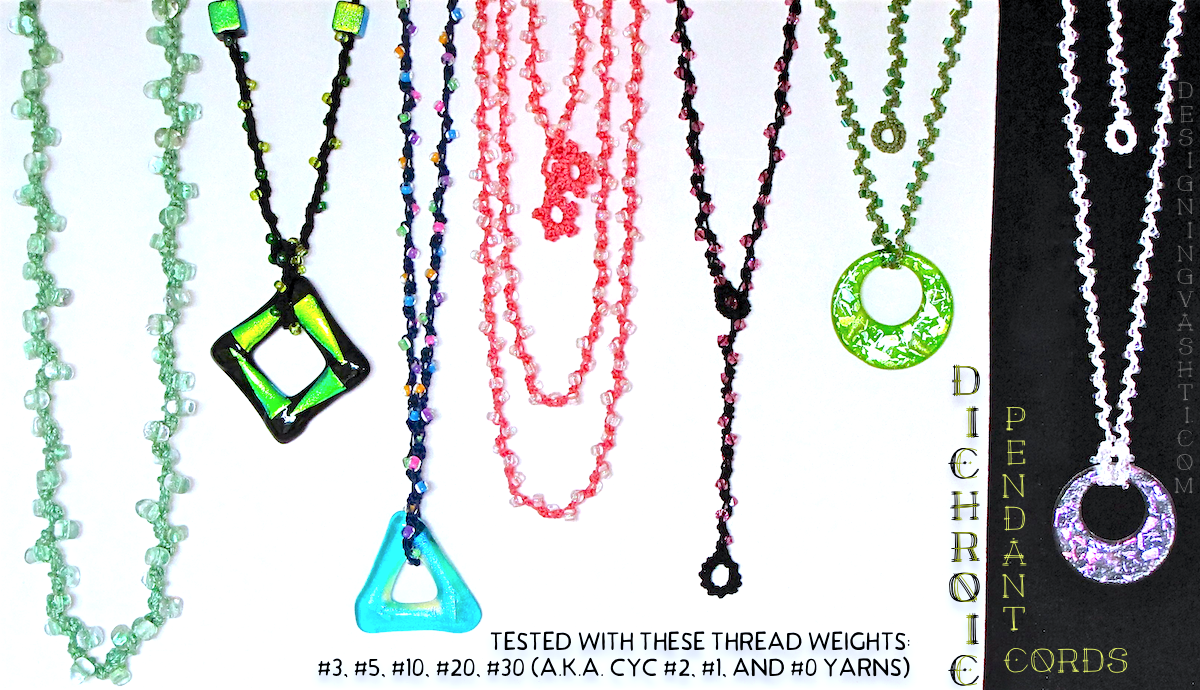 |
| Dichroic Pendant Cords (pattern is adjusted for different thread weights) |
Size #30 crochet thread: As with Size #10 & #20 threads, equivalent yarn weight names are not helpful with these extra fine threads. For the best looking and lasting crochet jewelry, use a “6-cord” thread, although it's difficult to find it in modern colors.
 |
| Palmetto Cuffs crocheted of yarns spanning the light sport to aran (heavy worsted) weight categories. The yarn of the smallest cuff is equivalent to the thickest thread size #3! |


Is it possible to substitute embroidery floss, perhaps 2 strands out of the 6, for #20 thread?
ReplyDeleteHi Water Pegasus :-)
ReplyDeleteThe short answer, based on my experience, is yes. My longer answer is that sometimes the substitution is not exactly equivalent. It might still be close enough, depending on your project.
It may be that strands of embroidery floss behave differently from most crochet threads because the floss has fewer plies that are twisted much less; or the intense dyes cause flosses to vary (this happens with different colors of the same yarn too); or the flosses vary in quality by brand or over time.
Bit late to say thank you, but I shall anyway as this question occurred to me again today, and here's where Google led me, once more. Ha ha. Thanks, Vashti. I've been trying needle tatting and so want to find thread equivalents.
ReplyDeleteFor crochet, perhaps the best way is to figure out if you're getting the same number of stitches per inch as with the equivalent thread or pattern suggestion? Personally, I'm not a fan of gauge swatches. I like to make small items, accessories more than clothes. That could always change though. :)
I absolutely love that I've stumbled onto your site in the midst of my searches to improve my crocheting! Until recently, I've only crocheted with regular old yarn, and not too terribly well. I do, however, make beaded jewelry and have recently decided to try using crochet in some of my pieces. While I have difficulty making squares and circles, straight lines are not so tough for me! I do have a question for you that I don't seem to see in your posts (unless I missed it while reading them!). When using crochet thread in jewelry, do you use thread conditioners? Why, or why not? And if so, which types do you prefer? Also, what are your feelings on bamboo crochet threads?
ReplyDeleteHey Julie, I have severe neuropathy in all my extremities so I crochet or do needle point every morning so my hands don't claw up. I used to only be able to do single crochet, but I bought a book called I taught myself to crochet and now I'm making all kinds of stuff and have gotten really good. My mother has crotched since she was a child and she is amazed at how good I've gotten and says I'm a lot better than she is. The book came in a set with a couple needles, stitch counter and some other things. I got it at Joanns, but I'm sure you can find it at any craft store. Just a thought for you if you really want to learn to crochet. The book has instructions and pictures of the stiches so its really easy to follow.
DeleteTry making a Granny Square. They are pretty foolproof.
DeleteHi Julie,
ReplyDeleteI don't use thread conditioners, only because I haven't tried them yet. I haven't been in a hurry to, because I tend to prefer threads that do not already have sizing or starches or waxes in them. I'd like to experiment sometime though.
I've used several bamboo yarns and only one bamboo thread (Aunt Lydia's brand). I like it very much! I'm using it for a delicate lace scarf. I don't think I've used bamboo for jewelry so far. Thanks for writing!
Thank you so much for answering all my questions! I'm quite new to the idea of crocheting jewelry, and there are so many things I'm trying to figure out for ideas that I have, but there really doesn't seem to be any place to find the answers. I really appreciate you answering those questions for me, though! That gives me somewhere to start. :)
ReplyDeleteIf there's any way you can be in Reno Nevada this Sept. 13 for the Chain Link conference ( www.crochet.org ), the Creating Crochet Jewelry class I'll be teaching sounds like it would be exactly what you're looking for!
DeleteI would absolutely love to be able to, but due to health issues, I'm not able to travel on my own, and my significant other has rather large work responsibilities with the project he's responsible for. It's a bit of a major bummer to have to have a chaperone to make sure I'm okay, but it is a necessity, unfortunately.
ReplyDeleteI'm trying to make beaded crochet bracelets and the like, and seem to be having difficulty finding any bamboo crochet thread in a size 5. I've finally gotten a way (using Fireline and beading needle) to get my 11/0 seed beads to fit on size 10 crochet thread, but I'd like to see what size 5 looks like, feels like, works like, etc. Prior to embarking on this endeavor, I've only crocheted with Red Heart worsted weight acrylic yarn, and have made all my jewelry using beads, wire, headpins, eyepins, and the like. Will the class be available AFTER the fact online via any sort of video venue? I'd love to be able to view it!!
Hi, I have a crochet pattern that call for a #4 class yarn but I want to use a #3 crochet thread. How do I calculate the converstion/substitution?
ReplyDeleteHi Denise, those numbers make the yarn and thread sizes sound similar, but it's accidental--it's due to two different weight numbering systems.
ReplyDeleteA #4 yarn weight is generally "worsted weight" or "medium weight" for which a size H/8/5mm crochet hook is recommended (or nearby hook size; swatch to see what's best for your project).
A "Size 3" crochet thread is generally equivalent to a "sport weight" yarn, for which a size E/3.5mm crochet hook, or nearby size, is usually recommended.
Another way I've heard them compared is that a medium weight yarn is equivalent to two strands of a sport weight yarn. That's a big difference!
You can test this with the thread you want to use by swatching with two strands held together, and the hook size recommended in the pattern you wish to use. So if it looks and feels and drapes the way you like. Measure the stitches and rows per inch to see how it compares to the recommended gauge given in the pattern.
Good luck! Yarn substitutions are always a case-by-case experiment, more so if you're switching yarn for thread and vice versa.
I have wanted an opinion on the comparison of thread and worsted yarn for a long time but thought the question may have been null. I am so grateful to your genius. the fact that you share your knowledge freely is so greatly appreciated. I hope this doesn't sound too corny. But seriously you are one of the Great Ones, THANKS THANKS to Doris too!
DeleteSamantha, your comment seriously makes my day :-)
DeleteWhat size crochet thread can I substitute for #10 Lydias crochet thread. I'd like to create some botties out of a softer perhaps fingering sized yard, but the pattern calls for #10 cotton weight.
ReplyDeleteThank-you, April
Hi April,
DeleteI hope I 'm not too late in replying. Look for a yarn labeled "lace weight". This is a vague area of yarn weight numbering. Some are closer to #10 thread, some are so fine that they're closer to #20 or #30 thread!
You might also like some that are called "Light Fingering Weight". It helps to match the stitch gauge in the pattern with the recommended stitch gauge given on the yarn label, when it's available.
If you buy a lace weight yarn in a yarn shop, the shop employee should be able to help you understand the stitch gauge information on the label.
Good luck!
Hello I have a pattern for a baby dress in Number 10 cotton thread and want to do it in baby wool, as its for a winter baby, please can you tell me the ply I need to use for this?.
ReplyDeleteHi Patricia,
DeleteI think your question is similar to April's, although it sounds like you might be using UK terminology? It might be "1-ply" but I don't know the yarn weight system by "ply" very well. But you could try Googling something like "yarn weight systems US UK" or "yarn weight equivalents" and see what ply would be equivalent to "Lace Weight," or perhaps "Light Fingering Weight." ("Fingering Weight" is equivalent to the next thicker size of cotton thread, which is #5; so a yarn referred to as "Light Fingering Weight" might be closer to #10 thread.
Hope this helps some!
Thank you for this comparison. I've been all over the web looking for a list of how crochet weights and knitting weights compared, and yours has been the only real explanation I've found. Thank you for taking time to do this.
ReplyDeleteCheers!
Thanks for your comment, Toni!
DeleteHello, I have found a very old scarf pattern that uses six cord crochet thread and a size 12 needle (1955). What can I use in a wool equivalent instead. I am trying to make a "Sophie Diagard" style look. Do you have any suggestions?
ReplyDeleteThanks
Vicki
Hi Vicki,
DeleteA crochet hook labeled "size 12" varies in size among manufacturers, and in different years even by the same manufacturer! Keeping this disclaimer in mind, it sounds like an extra-fine thread was used such as size 50 or finer.
I have two extra-fine lace weight wool yarns in my stash: Lacey Lamb from Jade Sapphire, and Shetland Cobweb from Lacis. I don't remember where I put the Cobweb right now, but I tried the Lacey Lamb with 3 brands of "size 12" steel crochet hooks (Tulip, Clover, Boye), and the hooks seemed slightly too small. The yarn has a soft s-twist, so this also increased the amount of splitting and snagging with my hook. The Tulip and Clover were both labeled ".60mm". The next size larger Tulip on hand is "size 8, .90mm" (hmm, my size 10 .75mm is missing). It's a better size for Lacey Lamb.
Cobweb is finer than Lacey Lamb and is probably what you want. Pictured in my Ravelry stash: http://www.ravelry.com/people/vashtirama/stash/shetland-cobweb
I hope this helps to narrow things down a bit for you.
This comment has been removed by the author.
ReplyDeleteI have a pattern that calls for 30 crochet cotton can I find it anywhere in the colors that I need is there something I can substitute for it
ReplyDeleteThank you for this information! I have been searching all over and keep finding circular information. You have definitely made my day
ReplyDeleteGlad I could help!
DeleteHello! I'm getting into 'micro' crochet. I understand the crochet weight system. My question is: I'm seeing lots of embroidery thread marked as 50/3 weight, or 40 weight. I need mercerized cotton thread size 80. Can the embroidery thread be substituted? If so, how do you figure out the conversion? Thanks so much for your help!
ReplyDeleteSince I've never substituted threads that are intended for other needle arts for a size 80 mercerized crochet thread, I can't speak from experience. First, I would reel off some size 80 crochet thread and get to know how strong it is: try to break it with my hands and teeth; rub and scrape it along a rough edge to see how durable it is, and how its appearance changes. I'd untwist it and pull its plies apart, and try to break each ply. And then I'd crochet some stitches with it and see which crochet hook size feels best to use with it.
DeleteThen I'd take some other types of threads and do the same things with them. This is because I worry that some superfine embroidery threads might not be anywhere as strong as the crochet thread. When you try crocheting with each thread, use the same hook you liked with the crochet thread. See if it seems a bit thinner or thicker.
Hope this helps.
I have a knitted doily pattern that calls for Royal Society Six Cord Cordichet small ball, size 20; 2 balls. Is this the same as our size 20 now? Do you have any idea how many yards is on a small ball? It’s a beautiful pattern I would love to knit it.
ReplyDeleteI don't recall ever crocheting with Royal Society thread. Sounds lovely! You've given me an idea for a future blog post.
DeleteWithin the size 20 thread category there is room for some variation. This is true for all yarn and thread sizes. The best way to know how close it is to today's size 20 is to crochet with some currently produced size 20 threads, and then use the same crochet hook size and crochet with the Royal Society one. If it seems you need to go up or down more than a hook size or two, it might match up better with size 10 (thicker), or size 30 (thinner). Ideally have some of these sizes on hand to test with.
With the threads I have, it seems to me that there is a smaller difference between size 20 and 30 threads than between the size 10 and 20 threads.
I looked in Ravelry for info on your thread. They only list size 30 (has either 80 or 400 yds per ball) and size 5 (90 yds per ball).
https://www.ravelry.com/yarns/brands/royal-society/yarns
Here's how the amount per ball changes among DMC's Cordonnet, as a rough proportional comparison: size 10, 124 yds; size 20, 174 yds; size 30, 216 yds. (All DMC balls weigh 20 grams. I don't know the weights of the Royal Society balls.)
Hi Vashti,
ReplyDeleteI do a lot of crochet and now I am experimenting to work out little flowers and leaves as seen in Japaneses crochet. These are super tiny and would like your advice on Crochet thread size and hook size please.
Thank you.
I have a just used the last of a ball of Aunt Lydia's thread on project but not finished. Need to buy more thread but the wrapper states Article 151, Color 201. I believe this is Size 10, white but would like to verify before purchasing more.
ReplyDeleteMy pattern calls for fingering yarn want to use crochet cotton number 10 will there be much difference in size
ReplyDeleteYes. Fingering yarn is thicker than size 10 crochet thread. The thicker size 5 crochet thread is a closer match to fingering yarn.
Delete